Table of contents

When engineers need to rotate massive loads slowly while ensuring the equipment stays securely in place once the motor stops, they turn to one specific mechanical pairing: the slewing ring with worm gear.
Often referred to as a worm-driven slew drive, this assembly is a masterpiece of compact power transmission. By combining the heavy-load carrying capacity of a slewing bearing with the unique physics of a worm shaft, manufacturers can achieve incredible rotational control.
If you are evaluating motion control options for your next heavy-duty project, this post will explore the mechanics, the unique safety advantages, and the trending applications of this specific drive type.
The Mechanics: How It Transmits Power
To understand why this system is so effective, we have to look at how the two components interact inside the enclosed housing.
Unlike planetary or spur gear systems, a slewing ring with worm gear operates on a 90-degree axis. The driving mechanism (the worm) looks like a threaded screw. As this worm shaft rotates, its threads engage with the gear teeth machined onto the outer edge of the slewing ring.
This perpendicular engagement creates a sliding friction mechanism rather than a pure rolling action. The result? A massive gear reduction ratio packed into a very small footprint. A single rotation of the worm shaft might only move the slewing ring by a fraction of a degree, translating into incredibly smooth, low-speed, high-torque output.
The “Self-Locking” Advantage (Why Engineers Choose It)
If you look at technical forums, one of the most highly searched queries regarding these drives is about static holding torque and braking. This is where the worm gear design truly outshines the competition.
Because of the steep angle of the gear teeth, power can easily flow from the worm to the slewing ring. However, it is mechanically near-impossible for the load to push back and turn the worm shaft. This creates a natural self-locking or back-driving prevention feature.
Why does this matter?
- Safety: If a power failure occurs on a truck-mounted crane or a manlift, gravity or wind cannot force the boom arm to spin out of control. The worm gear acts as a natural brake.
- Cost Efficiency: In many applications, the self-locking nature eliminates the need to buy and install expensive external mechanical braking systems.
Top Industrial Applications
Due to its high holding torque and compact design, the slewing ring with worm gear is the default choice for several demanding industries:
1. Solar Tracking Systems
In utility-scale solar farms, solar panels must track the sun at a creeping pace, yet withstand brutal wind storms when stationary. The worm gear slew drive provides the micro-adjustments needed for tracking, while its self-locking nature holds the heavy panel arrays rigid against wind gusts, protecting the infrastructure.
2. Aerial Work Platforms (AWP) and Manlifts
When human lives are suspended in a bucket 50 feet in the air, stability is non-negotiable. The smooth, jerk-free rotation provided by the worm gear ensures operator safety, while the self-locking mechanics guarantee the basket will not drift once positioned.
3. Truck-Mounted Cranes and Utility Derricks
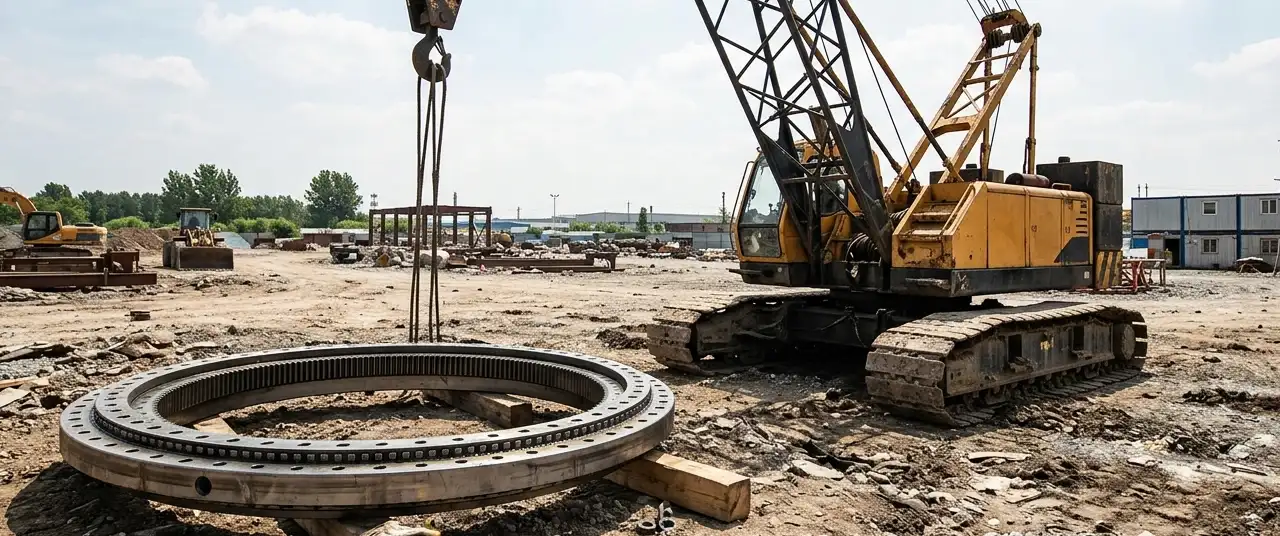
Mobile cranes require a robust rotation mechanism that can handle shifting dynamic loads. The enclosed housing of a worm-driven slewing ring protects the internal gears from job site mud, debris, and weather, while delivering the brute force needed to swing heavy materials.
Maintenance Tip: Managing Backlash
While highly durable, the sliding friction of a worm gear generates heat and causes gradual wear over time. A common long-tail search among maintenance technicians is “how to fix slew drive backlash.”
Backlash is the slight “play” or wobble that occurs when the gear teeth wear down. Because a slewing ring with worm gear relies on tight meshing, excessive backlash can compromise precision.
- Lubrication is Key: Always adhere to the manufacturer’s grease schedule. Worm gears require specialized high-pressure lubricants to minimize wear from sliding friction.
- Adjustable Housings: Many modern, high-end worm slew drives feature an eccentric shaft or adjustable housing. This allows maintenance teams to physically push the worm closer into the slewing ring teeth, closing the gap and eliminating backlash without having to replace the entire unit.
Final Thoughts
A slewing ring with worm gear is not designed for high-speed rotation. However, if your application demands immense torque, weather-sealed durability, and fail-safe holding power, it remains the undisputed champion of the mechanical engineering world.