Table of contents

When it comes to heavy machinery, the ability to rotate a massive load with precision is critical. This is made possible by the slewing bearing (also known as a turntable bearing). But beyond the obvious use in cranes, what is the full scope of a slewing bearing application?
In this guide, we explore the diverse industries that rely on these components, the technical reasons for their use, and how to select the right one for your specific project.
1. Construction and Earthmoving Machinery
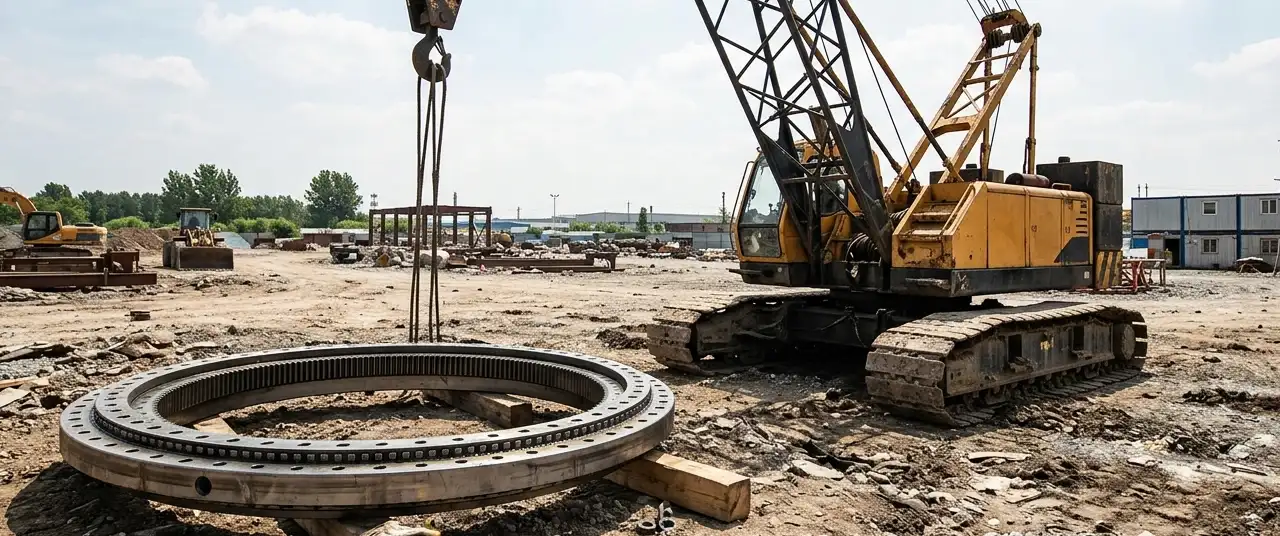
The most recognizable slewing bearing application is in the construction sector. Any machine that requires a “swing” motion uses a slewing ring as its central pivot point.
Excavators: The “swing circle” allows the upper cab to rotate 360° independently of the tracks.
Tower Cranes: Slewing bearings support the massive horizontal jib and the weight of the counter-weights.
Concrete Pumps: They enable the boom to reach various angles and heights on a job site.
2. Renewable Energy: Wind and Solar
As the world shifts toward green energy, slewing bearings have become foundational to power generation.
Wind Turbines: Every modern wind turbine uses two types of slewing bearings. Yaw bearings rotate the nacelle to face the wind, while pitch bearings adjust the angle of the blades to optimize wind capture.
Solar Trackers: To maximize efficiency, solar panels must follow the sun. Heavy-duty slewing drives (an enclosed bearing system) provide the slow, high-torque rotation needed for large solar arrays.
3. Medical Equipment (Precision Applications)
Not every slewing bearing application involves tons of dirt or steel. In the medical field, precision and silence are the priorities.
CT and MRI Scanners: These machines require high-speed, extremely quiet rotation to move sensors around a patient.
Operating Tables: Slewing rings allow for smooth, multi-axis positioning of patients during delicate surgeries.
Efficiency in the warehouse and at the port depends on reliable rotation.
| Application | Function of the Bearing |
|---|---|
| Port Cranes | Loading/unloading shipping containers from vessels. |
| Forklift Attachments | Rotating clamps or forks for specialized pallet handling. |
| Automated Guided Vehicles (AGVs) | Steering mechanisms for robotic warehouse carts. |
| Palletizers | High-speed rotation for stacking goods in packaging lines. |
5. Industrial Robotics and Automation
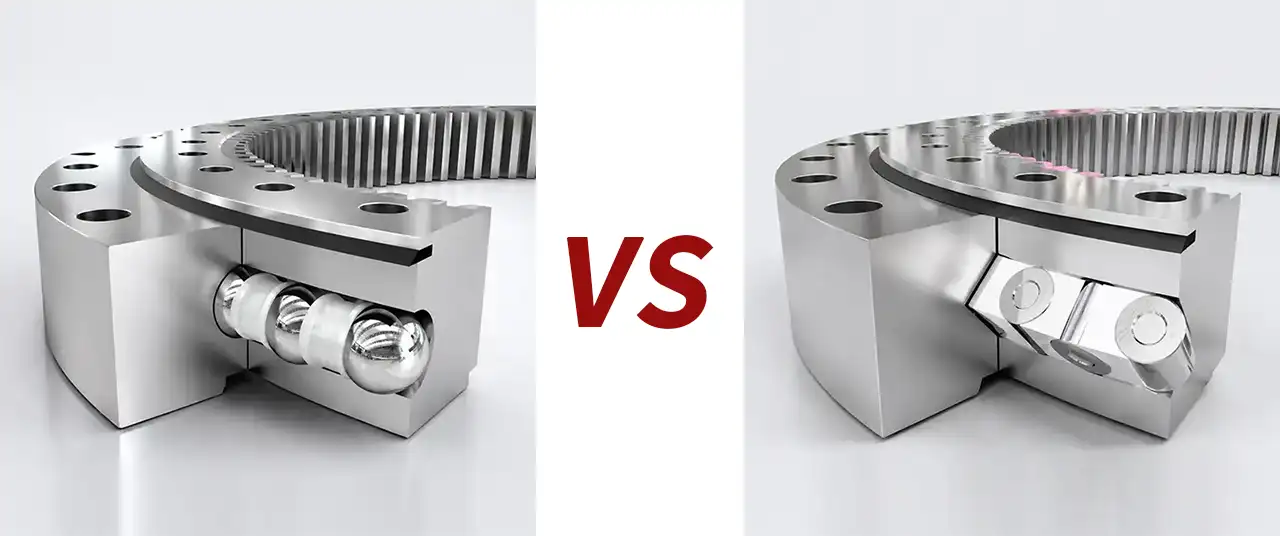
Modern factories use “Crossed Roller” slewing bearings for their exceptional rigidity. In robotics, the slewing bearing application is found in the “waist” or base of the robot, allowing for a wide range of motion while maintaining sub-millimeter precision.
6. How to Choose the Right Slewing Bearing
Choosing a bearing depends entirely on your specific application’s load profile. Engineers typically categorize the selection based on these three factors:
Load Direction
Does your application face vertical pressure (Axial), side pressure (Radial), or a tendency to tip over (Moment)?
Formula for Overturning Moment: M=F×d (Where M is the moment, F is the load force, and d is the distance from the center).
Environment
Offshore/Marine: Requires specialized anti-corrosion coatings and stainless steel components.
Mining: Needs heavy-duty seals to prevent coal dust or grit from entering the raceways.
Gearing Requirements
Internal Gear: Keeps the drive motor protected inside the bearing.
External Gear: Offers easier access for maintenance and allows for higher torque via larger pinions.
Gearless: Used when the rotation is driven by external cylinders or belts.
Summary: The Versatility of Slewing Bearings
From the depths of a mine to the precision of a surgical suite, the slewing bearing application is everywhere. They are the essential link that allows heavy structures to move with fluidity and safety.
Looking for the perfect bearing for your application? [Browse our Slewing Bearing Catalog] | [Request a Technical Consultation]