Table of contents
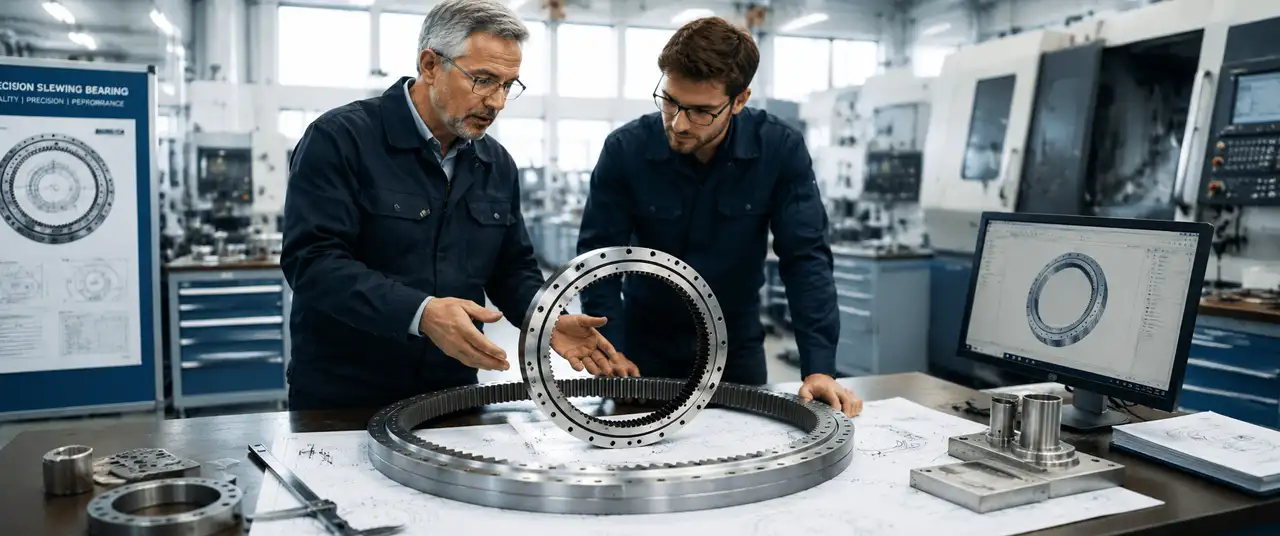
An engineer we’ll call Mia is specifying a slewing bearing for a new rotating platform design. She has three options on the table — single row, double row, and cross roller — and, like most people at this stage, isn’t sure yet which one actually fits. Here’s how she works through it.
First Instinct: “I’ll Just Pick the Middle Option”
Mia’s first draft spec lists a double-row ball bearing, mostly because it sounds like a reasonable middle ground between “basic” and “heavy duty.” Her supplier’s technical rep asks a fair question before quoting anything: what’s the load actually doing — is it mostly straight down, mostly sideways, or does it need to stay perfectly rigid with no play at all?
Mia realizes she hasn’t actually answered that yet.
Working Backward From the Load
She goes back to her load calculations. Her platform carries a moderate, fairly evenly distributed weight, with only a small amount of moment load since the load stays close to the center of rotation. No unusual precision requirement — a small amount of rotational play won’t affect the platform’s function.
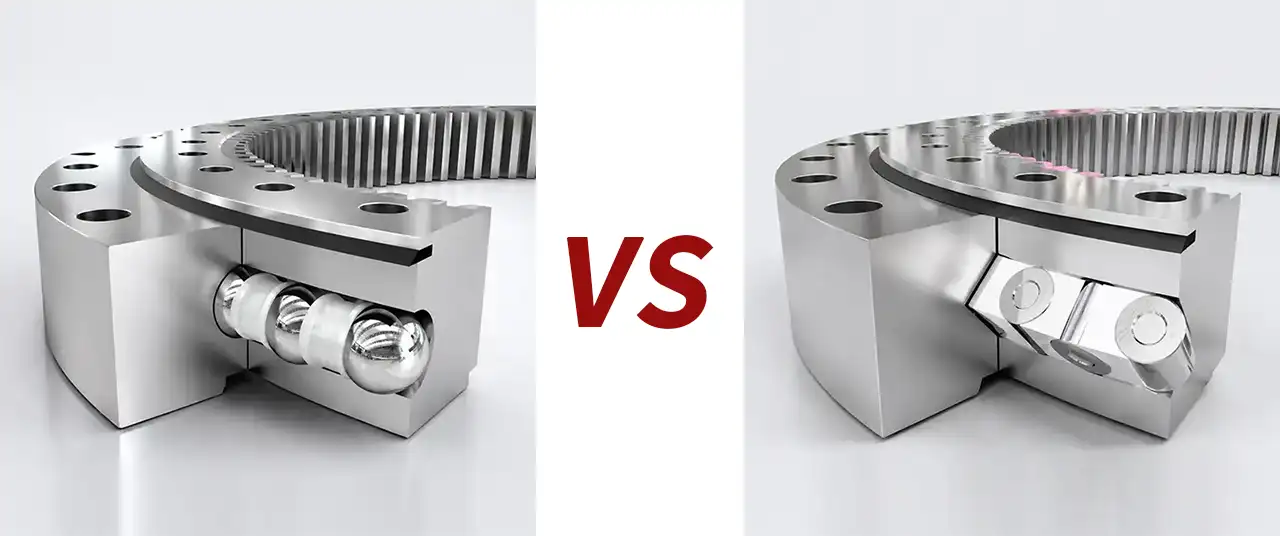
That description matches a single-row four-point contact ball bearing far better than the double-row option she’d defaulted to. Single-row bearings are built for exactly this: moderate, fairly balanced axial, radial, and moment loads, at a lower cost than heavier configurations.
A Second Scenario: When Double Row Actually Wins
Mia’s colleague, working on a different project — a compact crane arm — runs the same exercise. His load is different: the arm extends well beyond the base, creating a real tipping moment on top of a meaningful axial load from the structure’s weight.
For him, a single-row bearing would be undersized on moment capacity. A double-row ball bearing, with two rows of balls at different diameters splitting axial and moment load between them, matches his situation — which is exactly why double-row bearings are the standard choice for tower cranes and similar equipment with an extended, load-bearing arm.
A Third Scenario: When the Real Requirement Is Precision, Not Strength
A third colleague is specifying a rotary joint for a robotic arm. The loads involved are modest — nothing like the crane arm — but even a small amount of backlash at the base joint gets magnified into positioning error at the tool tip.
Neither single-row nor double-row ball bearings are built to minimize play; they’re built to carry load efficiently, with some inherent clearance. A cross roller bearing, with rollers set at 90 degrees to each other in a single row, is specifically designed to nearly eliminate radial play and deliver high rotational accuracy — making it the clear fit here, even though its load capacity isn’t the highest of the three.
The Pattern Across All Three Stories
| Engineer’s Situation | Dominant Requirement | Right Choice |
|---|---|---|
| Mia’s rotating platform | Moderate, balanced load | Single-row ball |
| Colleague’s crane arm | High axial + moment load | Double-row ball |
| Colleague’s robotic joint | Precision, minimal play | Cross roller |
Notice that none of these three engineers chose based on “which one sounds stronger” or “what’s commonly used.” Each one worked backward from what their application actually demanded — load magnitude and direction, or precision — and the right type followed from that.
Applying This to Your Own Selection
Before comparing single row, double row, and cross roller on a spec sheet, spend five minutes answering the same question Mia’s supplier asked her: is your load mostly balanced, does it involve a significant tipping moment, or does precision matter more than raw capacity? That one question does most of the selection work before you ever look at a load rating table.