Table of contents
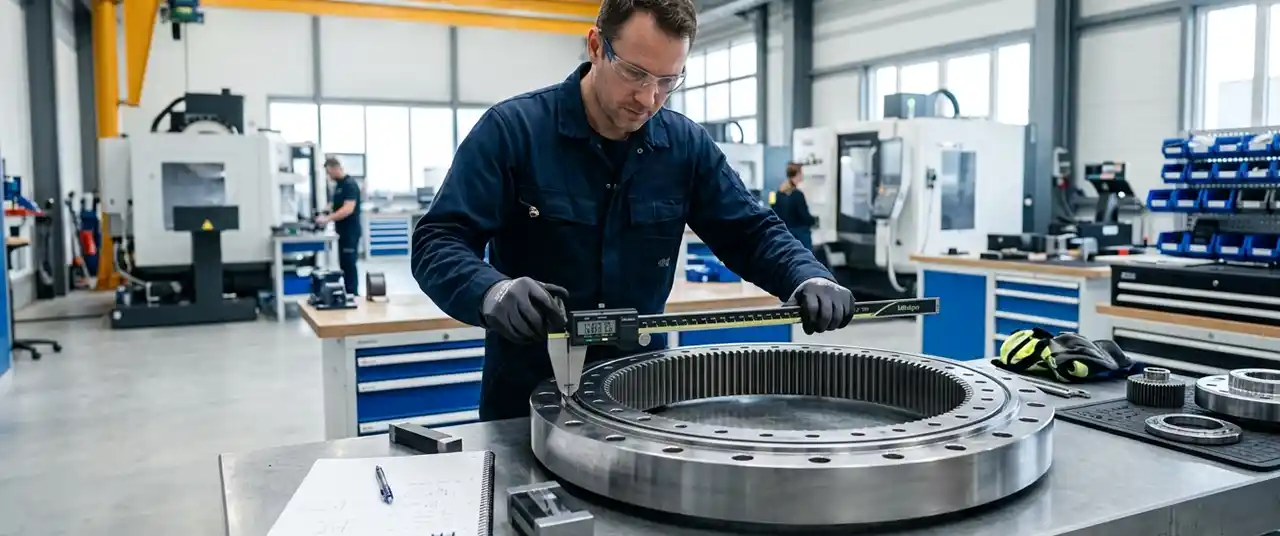
Selecting the right rotational component for heavy machinery is one of the most critical decisions an engineer can make. If a bearing is undersized, you risk catastrophic equipment failure. If it is oversized, you waste valuable space and budget.
So, how to choose the correct slewing ring size? It requires more than just measuring the diameter of your mounting space. You must thoroughly analyze your load profile, environmental conditions, and gearing requirements.
In this comprehensive guide, we will walk you through the step-by-step process of sizing a turntable bearing for your specific application.
Step 1: Calculate Your Load Profile (The Most Critical Step)
Before looking at a catalog, you must understand the forces your machine will exert on the bearing. Slewing rings are unique because they handle three types of loads simultaneously:
- Axial Load: The total downward weight pressing on the bearing. This includes the weight of the rotating upper structure and any payload it is carrying.
- Radial Load: The horizontal (side-to-side) forces acting on the bearing. These are often caused by wind pressure, centrifugal force during rotation, or the machinery pushing against an object (like an excavator digging).
- Moment (Overturning) Load: This is the twisting force created when a heavy payload is suspended away from the center of rotation.
To determine the turntable bearing load capacity you need, you must calculate the maximum overturning moment using this formula:
(Where M is the Moment Load, F is the Force/Weight of the payload, and L is the distance from the payload’s center of gravity to the bearing’s center of rotation).
Step 2: Determine the Required Safety Factor
Your calculated loads represent the theoretical maximums. However, real-world applications involve shock loads, vibrations, and unpredictable forces.
Consequently, you must apply an Application Factor (Safety Factor) to your calculations.
- A smooth-running industrial turntable might require a safety factor of 1.2.
- A heavy-duty forestry crane or mining excavator experiencing severe shock loads might require a safety factor of 2.0 or higher.
Multiply your static loads by this safety factor before selecting a bearing size.
Step 3: Select the Right Internal Bearing Structure
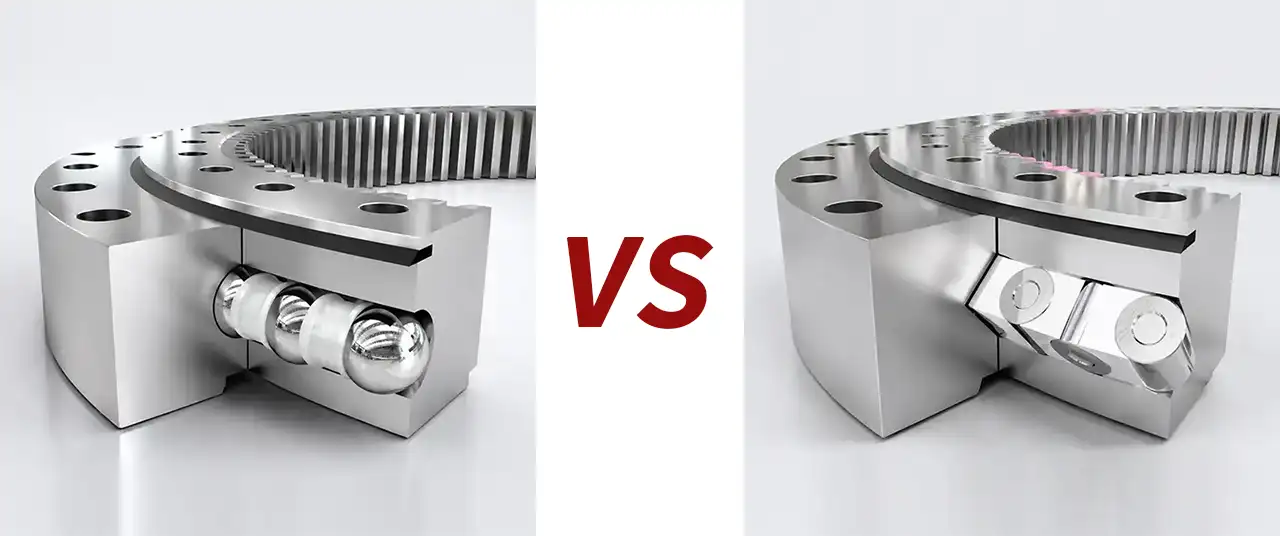
Once you know your loads, you must decide which type of internal geometry best supports them. How to choose the correct slewing ring size heavily depends on picking the right style:
- Single-Row Four-Point Contact Ball: Excellent for light-to-medium applications (e.g., small cranes, packaging machinery). They offer a great balance of size and cost-effectiveness.
- Double-Row Ball: Provides higher stability for heavier, fluctuating loads.
- Crossed Cylindrical Roller: Offers exceptional rigidity and precision. Ideal for radar antennas and robotics where deflection must be minimized.
- Three-Row Roller: The ultimate choice for extreme loads. These are the go-to heavy-duty slewing rings for offshore drilling platforms and massive port cranes.
Step 4: Choose Your Gearing Requirements
Slewing rings can act as the structural joint and the drive mechanism. Depending on your motor and pinion setup, you will need to specify one of three gearing options:
- Internal Gear: The gear teeth are cut into the inner ring. This protects the gears from external dirt and debris, making it ideal for harsh environments like mining.
- External Gear: The teeth are on the outer ring. This allows for a larger pinion gear, resulting in higher torque output, and makes maintenance/lubrication easier.
- Gearless: Used when the machinery is rotated by an external mechanism, such as hydraulic cylinders.
Step 5: Factor in Rotational Speed and Environment
Your operating environment will dictate the final specifications of your bearing size and material:
- Rotational Speed (RPM): Ball bearings handle higher speeds better than roller bearings. If your application requires continuous, high-speed rotation, your size and type selection will change.
- Temperature and Sealing: Will the bearing operate in a dusty quarry or a corrosive marine environment? High-quality nitrile or silicone seals are required to keep abrasive particles out.
- Corrosion Resistance: For offshore applications, standard steel may rust. You may need to specify zinc plating, specialized epoxy coatings, or stainless steel materials.
Step 6: Consult the Manufacturer’s Load Capacity Chart
Finally, take your factored loads and consult a manufacturer’s Static Load Curve Chart.
Every slewing ring comes with a chart showing the safe operating zone based on the relationship between the Axial Load and the Moment Load. If your calculated data point falls below the curve, the bearing size is safe. If it falls above the curve, you must select a larger diameter or a heavier-duty internal design.
Summary
Figuring out how to choose the correct slewing ring size doesn’t have to be guesswork. By accurately calculating your axial, radial, and moment loads, applying the correct safety factors, and understanding your environmental constraints, you can confidently specify a bearing that will deliver years of reliable service.
Are you still unsure which size fits your exact application? It is always best to consult with an expert.
Contact our engineering team today for a free load analysis and bearing sizing recommendation!