Table of contents
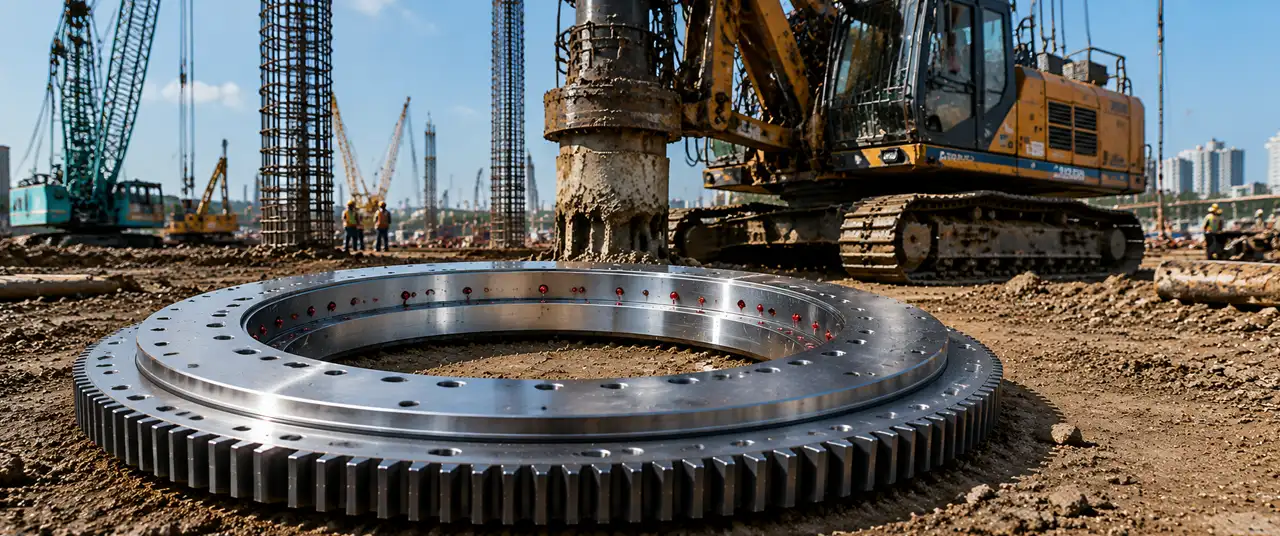
You’ve probably watched a crane swing a heavy load through a full circle without wobbling, or seen a wind turbine slowly turn to face the wind. Both rely on the same mechanism. Below, we answer the questions people actually ask when they’re trying to understand how a slewing bearing works — starting simple, then going deeper.
Q: In the simplest terms, what does a slewing bearing actually do?
It lets one part of a machine rotate smoothly on top of another part, while still holding that rotating part firmly in place under a heavy, often off-balance load.
Picture a lazy Susan on a dinner table — except instead of a bowl of rice, it’s carrying several tons of steel, and instead of your hand, a motor is turning it.
Q: What’s physically happening inside the bearing while it rotates?
Three things happen at once:
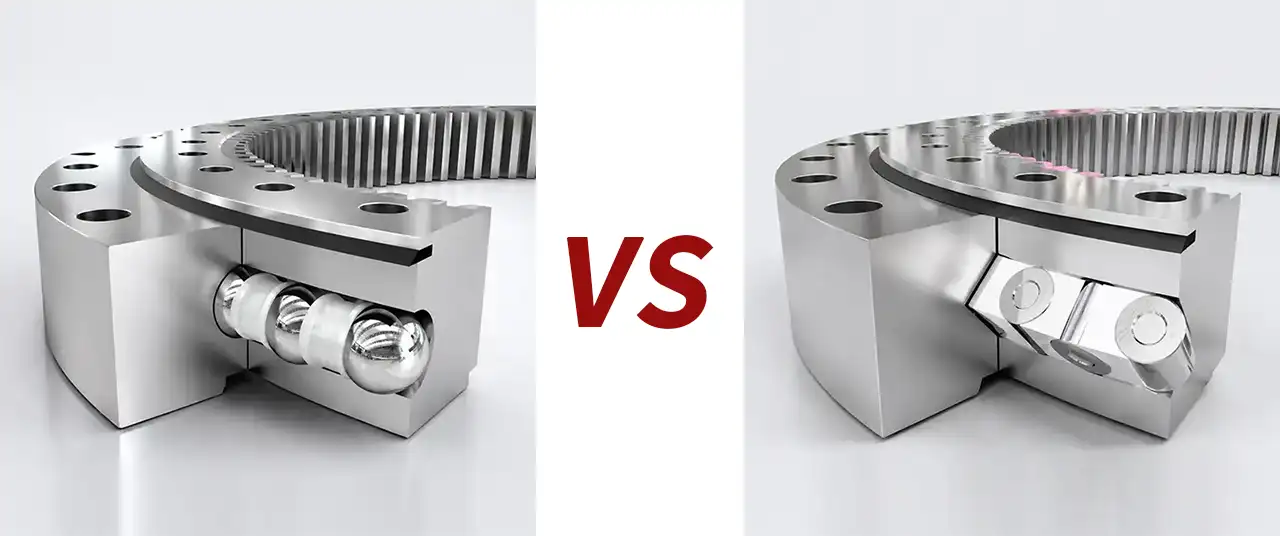
- The load gets transferred. Force from the rotating structure pushes down onto the bearing’s rolling elements — balls or rollers — sitting in a hardened raceway.
- The rolling elements roll, not slide. This is the whole point of a bearing: rolling friction is dramatically lower than sliding friction, so rotation stays smooth even under heavy load.
- One ring stays still, one ring turns. Bolts fix the inner ring to one structure and the outer ring to another (or vice versa). As the machine rotates, only one ring actually moves — the other stays anchored.
Q: Why does a slewing bearing need to handle three kinds of load?
Because real machines rarely apply force in just one direction. A slewing bearing is specifically engineered to manage all three simultaneously:
- Axial load — pressing straight down along the rotation axis, like the sheer weight of the structure above it
- Radial load — pushing sideways, perpendicular to the axis
- Moment load — a tilting force created when the load is off-center, like a crane boom extended out to one side
A standard ball or roller bearing is usually built for just one of these. A slewing bearing’s raceway geometry and rolling element arrangement are designed specifically to absorb all three without the rings separating or binding.
Q: How does the rotation actually get powered?
Two common setups:
- Geared drive — the slewing bearing has gear teeth cut into its inner or outer ring. A motor turns a small pinion gear that meshes with these teeth, driving the rotation directly.
- External drive system — the bearing itself has no gear; rotation is powered by a separate mechanism (like hydraulic cylinders or a chain drive) mounted elsewhere on the machine.
Geared slewing bearings are far more common because they combine the bearing and drive interface into a single compact component.
Q: What keeps it turning smoothly for years without seizing up?
Two things, mainly:
- Lubrication. Grease sits between the rolling elements and raceway, reducing friction and pushing out contaminants. Without regular re-lubrication, a slewing bearing wears out fast — this is the single most common cause of premature failure.
- Sealing. Rubber or synthetic seals on both sides of the bearing keep dust, water, and grit from entering the raceway, which would otherwise grind away at the hardened steel surface.
Q: Does the rotation speed matter for how it works?
Yes. Slewing bearings are built for low-speed, high-load rotation — typically just a few rotations per minute, not thousands of RPM like a car wheel bearing. That’s an intentional trade-off: the design prioritizes carrying enormous, uneven loads over spinning fast.
Q: So what actually causes a slewing bearing to fail?
In practice, it almost always comes down to one of three things:
- Grease starvation (skipped or infrequent lubrication)
- Contamination getting past worn or damaged seals
- Overloading beyond the bearing’s rated capacity
Understanding how the bearing works makes it obvious why: once rolling friction turns into metal-on-metal grinding, wear accelerates fast, and there’s no coming back from it.
The Short Version
A slewing bearing works by letting rolling elements carry axial, radial, and moment loads at once, while one ring stays fixed and the other rotates — powered either by its own gear teeth or an external drive. Keep it greased, keep it sealed, and keep it within its rated load, and it will keep turning reliably for years.
Want to know how to size a slewing bearing correctly for your machine? That’s exactly what we cover next.