Table of contents
When engineering heavy machinery, selecting the right rotational joint is crucial for long-term reliability. Specifically, engineers frequently debate between a cross roller vs four point contact slewing bearing. Choosing the wrong internal structure can lead to excessive friction, poor rigidity, or catastrophic mechanical failure under heavy loads.
Therefore, understanding the fundamental differences between these two popular bearing types is essential. In this comprehensive comparison, we will explore their structural designs, load capacities, and ideal industrial applications to help you make the best procurement decision.
Understanding Cross Roller vs Four Point Contact Slewing Bearings
At first glance, both types of slewing rings look identical from the outside. Manufacturers machine both variants with inner and outer rings, mounting holes, and optional gear teeth. However, the critical difference lies entirely within the internal raceway and the rolling elements they utilize.
To evaluate a cross roller vs four point contact slewing bearing properly, you must analyze how these internal components interact with applied structural forces.
Internal Structure Differences
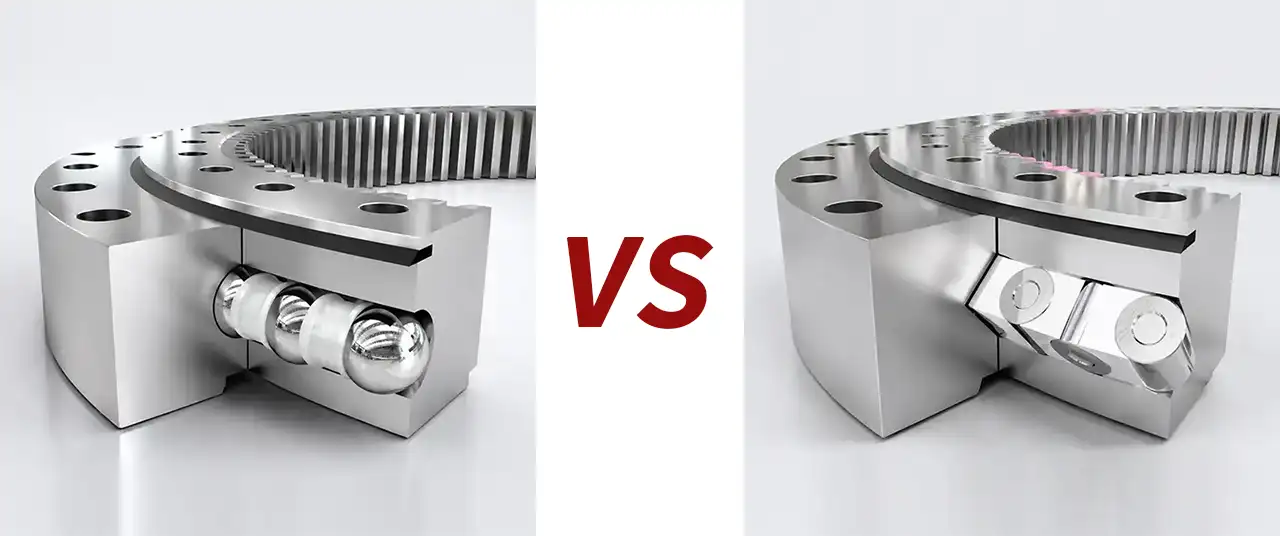
First, let us examine the four-point contact ball bearing. As the name suggests, this design uses spherical steel balls as the rolling elements. The raceway features a specialized gothic arch profile. Consequently, each steel ball touches the raceway at exactly four points. This unique geometry allows a single row of balls to handle axial, radial, and moment loads simultaneously.
Conversely, the cross roller bearing uses cylindrical steel rollers instead of spheres. Inside the raceway, engineers arrange these rollers in an alternating, 90-degree crisscross pattern. Because they are cylinders, they create a “line contact” with the raceway surface rather than a “point contact.” This structural distinction fundamentally changes how the bearing absorbs heavy stress.
Performance Comparison
When you compare a cross roller vs four point contact slewing bearing, performance metrics vary significantly based on their contact areas.
Load Capacity & Rigidity
Because cross roller bearings utilize line contact, they distribute weight over a much larger surface area. Therefore, they offer superior dynamic load capacity and structural rigidity. When subjected to massive overturning moments—like those seen in heavy lifting or drilling—the cylindrical rollers resist deformation excellently.
On the other hand, four-point contact ball bearings rely on point contact. While they are incredibly versatile, they cannot match the raw stiffness of a roller bearing. If you apply an extreme tilting moment to a ball bearing, the localized stress at the four contact points increases rapidly, which can cause premature raceway spalling.
Rotational Friction & Speed
However, ball bearings possess a major advantage when it comes to rotational friction. Because spheres have a tiny contact area, a four-point contact bearing turns very smoothly with minimal resistance. Furthermore, this lower friction generates less heat, allowing the bearing to operate at slightly higher rotational speeds.
In contrast, the large contact area of cross rollers naturally generates higher friction. Therefore, cross roller bearings require more drive torque to initiate movement. They are generally better suited for slow, highly controlled rotational applications where stability is the top priority.
Best Applications for Each Type
Ultimately, the choice between a cross roller vs four point contact slewing bearing depends on your specific machine’s working environment and load requirements.
You should choose a four-point contact ball slewing bearing for:
- Light to Medium Duty Cranes: Where smooth rotation and cost-effectiveness are priorities.
- Wind Turbine Pitch Systems: Where flexibility is needed to handle structural deformation from wind gusts.
- Material Handling Automation: Where lower starting torque and faster speeds are beneficial.
You should upgrade to a cross roller slewing bearing for:
- Heavy-Duty Excavators: Where massive shock loads and extreme rigidity are mandatory.
- High-Precision Machine Tools: Where you must eliminate rotational deflection entirely.
- Radar and Military Equipment: Where pinpoint accuracy and zero clearance are critical.
Make the Right Engineering Choice Today
In conclusion, analyzing the cross roller vs four point contact slewing bearing comes down to balancing rigidity against friction. If you need maximum stiffness and heavy load support, choose the cross roller. If you require smooth operation, versatility, and cost-efficiency, the four-point contact ball bearing is your best option.
Are you still unsure which slewing ring design fits your project? Contact our engineering team today. We can review your technical specifications, provide a 3D CAD model, and offer a competitive quote tailored to your exact application.