Table of contents
When you are engineering heavy machinery like mining excavators, offshore cranes, or giant wind turbines, standard ball bearings simply cannot handle the astronomical forces involved. When the stakes are high and the loads are massive, the industry standard shifts to a much more robust solution: the roller bearing slewing ring.
If you are an engineer, procurement manager, or heavy equipment mechanic, understanding the nuances of these heavy-duty rotational joints is crucial. In this comprehensive guide, we will break down what makes roller-style slewing rings unique, compare them to standard ball designs, and explore the different configurations available on the market today.
What is a Roller Bearing Slewing Ring?
A roller bearing slewing ring is a large-diameter rotational joint designed to connect a stationary base to a rotating upper structure.
Unlike standard bearings that use spherical steel balls to reduce friction, this type of bearing uses cylindrical rollers. Because a cylinder has a much larger contact area (a flat line) against the raceway compared to a sphere (a single point), roller bearings boast a drastically higher slewing bearing load capacity.
They are engineered to simultaneously support intense axial loads (downward weight), radial loads (side-to-side forces), and extreme overturning moments (tilting forces caused by heavy, off-center payloads).
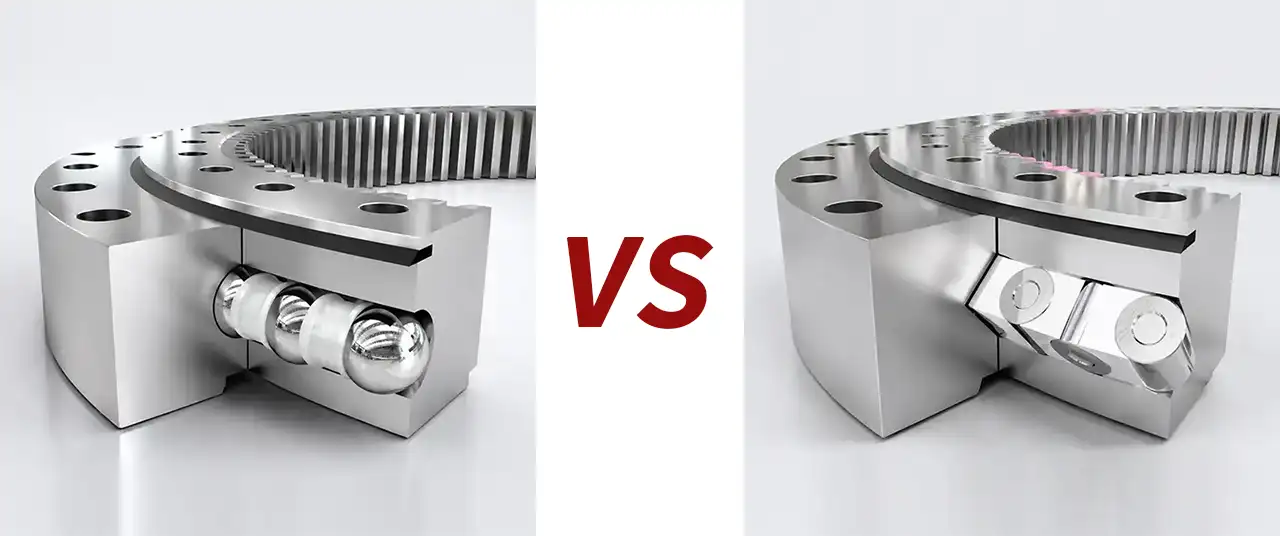
Roller vs Ball Slewing Bearing: Which Do You Need?
When sizing a rotational drive for your equipment, the most common debate is choosing between a ball or roller design. Here is a quick breakdown to help you decide:
- Ball Slewing Bearings: These are ideal for lighter loads, faster rotational speeds, and applications where smooth, continuous motion is prioritized. They are highly cost-effective and commonly found in small cranes, packaging machinery, and light automation turntables.
- Roller Slewing Bearings: These are built for raw strength and extreme rigidity. While they operate at slower rotational speeds and require more precise machining (making them more expensive), they will not deform under crushing weights. If you are building a massive tower crane or a tunnel boring machine, a roller bearing is mandatory.
The Two Main Types of Roller Slewing Rings
Depending on your space constraints and load requirements, manufacturers typically offer two distinct roller bearing configurations.
1. Cross Roller Slewing Ring Bearing
A cross roller slewing ring bearing features a single row of cylindrical rollers arranged in a 90-degree crisscross pattern (alternating their orientation).
- The Advantage: This unique geometric layout allows a single row of rollers to handle axial, radial, and moment loads simultaneously. It provides incredible rotational accuracy and high rigidity while keeping the overall profile of the bearing very thin.
- Common Applications: High-precision robotics, radar antennas, machine tool tables, and medical imaging equipment (like CT scanners).
2. Three Row Roller Slewing Bearing
When you need to move mountains, this is the bearing you choose. A three row roller slewing bearing separates the load forces into three distinct rows of rollers. Two horizontal rows handle the massive downward and upward axial loads, while a third vertical row independently manages the radial side-loads.
- The Advantage: Because the loads are separated and distributed across multiple massive rollers, this design offers the absolute highest load capacity of any slewing ring on the market.
- Common Applications: Mega-excavators, ship-to-shore port cranes, offshore oil rigs, and large-scale wind turbine pitch and yaw systems.
Maintenance Tips for Heavy Duty Turntable Bearings
Because a roller bearing slewing ring represents a significant financial investment, maximizing its lifespan is critical. Without proper maintenance, even the strongest steel will succumb to friction and fatigue.
- Strict Lubrication: Cylindrical rollers generate more friction than balls. You must follow the manufacturer’s exact schedule for injecting Extreme Pressure (EP) lithium grease into the raceways.
- Monitor Internal Clearances: Use a dial indicator to measure the bearing’s axial and radial play annually. If the clearances exceed the manufacturer’s safety limits, the bearing must be replaced before it fails catastrophically.
- Check Bolt Torque: The intense vibration of heavy machinery will cause mounting bolts to stretch over time. Regularly verify that all high-tensile bolts are torqued to the correct specifications.
Conclusion
Whether you are utilizing the space-saving precision of a cross-roller design or the uncompromising brute strength of a three-row system, the roller bearing slewing ring is the undisputed king of heavy-duty rotational motion. By understanding your specific load requirements and committing to a rigorous maintenance schedule, you can ensure your heavy machinery operates safely and efficiently for years to come.