Table of contents
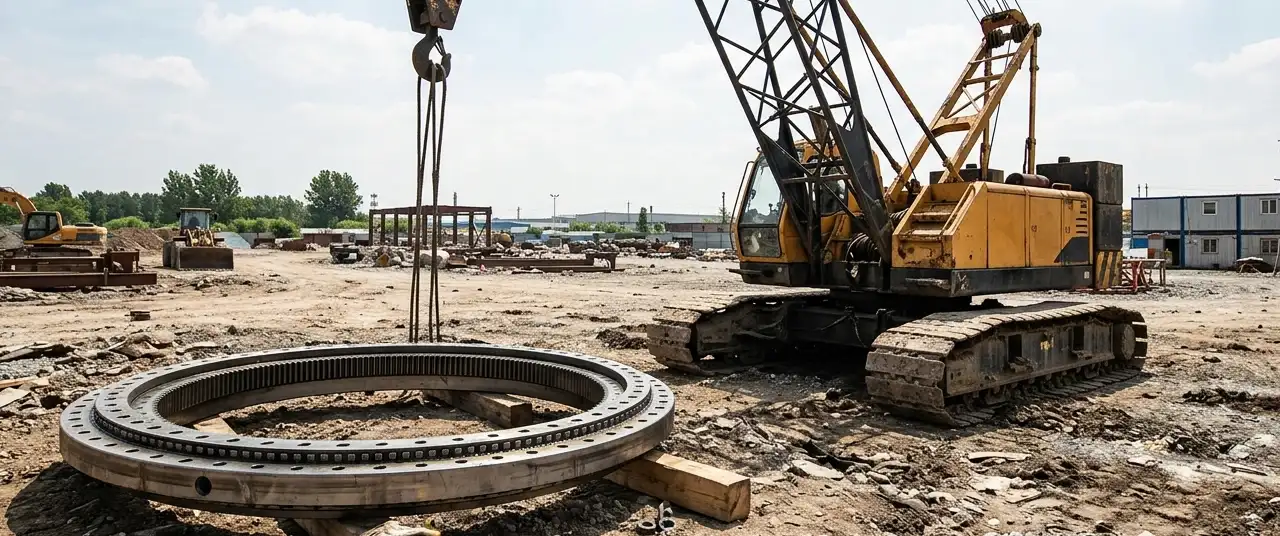
If you look at a massive construction crane, a wind turbine, or a heavy-duty excavator, you might wonder how such massive upper structures can rotate a full 360 degrees without snapping off their bases. The secret lies in a highly engineered, heavy-duty component known as the slewing bearing.
Whether you are a purchasing manager looking to source parts or a junior engineer learning about mechanical joints, understanding these components is essential. In this comprehensive guide, we will dive deep into the slewing bearing: what it is, how it works, and types explained, so you can make informed decisions for your next industrial project.
What Is a Slewing Bearing?
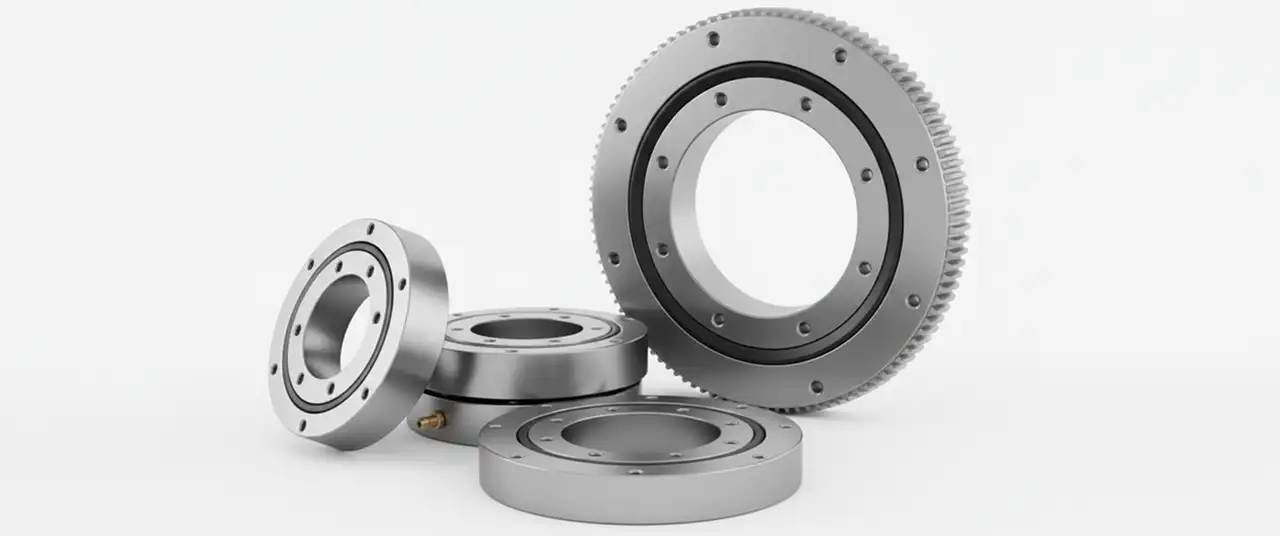
A slewing bearing (frequently referred to as a slewing ring or a turntable bearing) is a large-size, rotational rolling-element bearing.
Unlike standard ball bearings that fit onto small, rapidly spinning mechanical shafts (like those found in car wheels or electric motors), a slewing bearing is designed to act as a structural joint. It connects a stationary base to a rotating upper structure.
Furthermore, these bearings are uniquely engineered to handle extreme, complex loads simultaneously. A high-quality slewing ring bearing can support:
- Axial Loads: The immense downward weight of the machinery and its payload.
- Radial Loads: Horizontal, side-to-side forces pushed against the equipment.
- Moment (Overturning) Loads: The severe twisting forces created when a heavy weight is lifted far away from the center of gravity.
How Does a Slewing Bearing Work?
To understand how a slewing bearing works, it helps to look at its fundamental anatomy. Most turntable bearings consist of three primary components: an inner ring, an outer ring, and the rolling elements trapped between them.
- The Rings and Mounting: One ring is securely bolted to the stationary lower base of the machine, while the other ring is bolted to the rotating upper structure.
- The Rolling Elements: Precision-machined steel balls or cylindrical rollers sit in the raceway (the gap) between the two rings. These elements dramatically reduce friction, allowing the massive weight of the upper structure to glide smoothly over the lower structure.
- The Gearing System: This is what makes a slewing bearing truly special. In most applications, gear teeth are cut directly into either the inner or outer ring. A small drive motor with a pinion gear meshes with these teeth. When the motor turns the pinion gear, it forces the entire bearing—and the attached machinery—to rotate.
Types of Slewing Bearings Explained
Because no two industrial applications are exactly alike, manufacturers produce several distinct types of slewing bearings. Here is a breakdown of the four most common designs:
1. Single-Row Four-Point Contact Ball Bearings
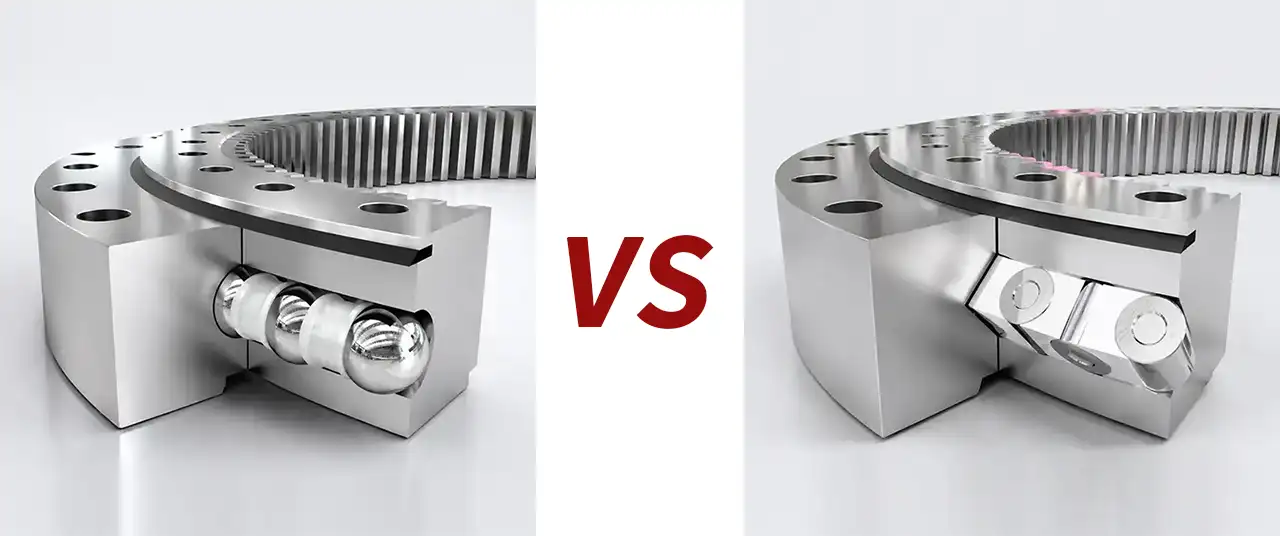
This is the most standard and widely used type of slewing ring. It features a single row of steel balls that make contact with the raceway at four specific points.
- Best for: Light to medium-duty applications where space and weight are primary concerns.
- Common Uses: Small cranes, industrial automation turntables, and packaging machinery.
2. Double-Row Ball Bearings
As the name suggests, this design uses two rows of steel balls. By distributing the mechanical stress across two rows, this bearing offers a significantly higher load capacity and better stability than the single-row version.
- Best for: Medium to heavy fluctuating loads that require a high safety factor.
- Common Uses: Excavator swing bearings, forestry equipment, and medium material-handling cranes.
3. Crossed Cylindrical Roller Bearings
Instead of spherical balls, this bearing uses cylindrical rollers arranged in a crisscross pattern. This unique geometric arrangement provides incredible rigidity and minimizes any internal clearance.
- Best for: Applications that demand whisper-quiet operation, minimal vibration, and extreme rotational precision.
- Common Uses: Radar antennas, medical equipment (like CT scanners), and advanced robotics.
4. Three-Row Roller Bearings
When you need to move mountains, you need a three-row roller bearing. This design features three distinct rows of rollers that independently handle axial, radial, and moment loads. This separation of forces allows the bearing to handle astronomical weights.
- Best for: The most extreme, heavy-duty industrial environments in the world.
- Common Uses: Massive offshore drilling platforms, ship-to-shore port cranes, and giant tunnel boring machines.
Conclusion
From ensuring that a solar panel tracks the sun perfectly to keeping a towering construction crane balanced, these rotational joints are the unsung heroes of modern engineering. By understanding the slewing bearing: what it is, how it works, and types explained, you are now better equipped to evaluate the right component for your specific machinery.